In February 2026, we went to Tenerife for a week. It was B’s first time she could remember going somewhere with a tropical climate. Here’s some nature play ideas for anyone else heading off on a warm holiday (free ones first, with some specific pay-to-do Tenerife ones later). Also some thoughts on what you need to pre-plan and what sounds great but is practically tricky with kids…
It starts on the plane…
We are not the best air travellers but, it has to be said, nothing beats flying on a plane for a whole new view of the world. We were lucky to get a great view of Tenerife as we came in to land. The Teide volcano dominated the landscape in a way you don’t see on the ground. Even more impressive was the weather. On the north side the island was covered in cloud while on the other it was desert and cloud free. We were suddenly all obsessed with weather systems. Going back we had sunset out our window. This led to conversations about which direction we must be flying in to see it.


Spotting new types of plant
B would not admit to being that interested in plants but Tenerife plants are different. The first thing she noticed was the cacti (cue discussion over whether it’s cacti or cactuses). She spent a lot of the week testing out the sharpness of different spikes.
Every tree was also a diversion. Tenerife has lots with big thick green leaves which fall off and become big brown leaves. We collected both and then dropped them off high up balconies to see which fell quicker. Bougainvillea plants provided beautiful flowers which got stuck in hair a lot. We went to a village where the almond trees were in bloom and picked blossom and discussed how you make marzipan. Then we saw an orange tree and a girl on her dad’s shoulders trying to reach one to pick.
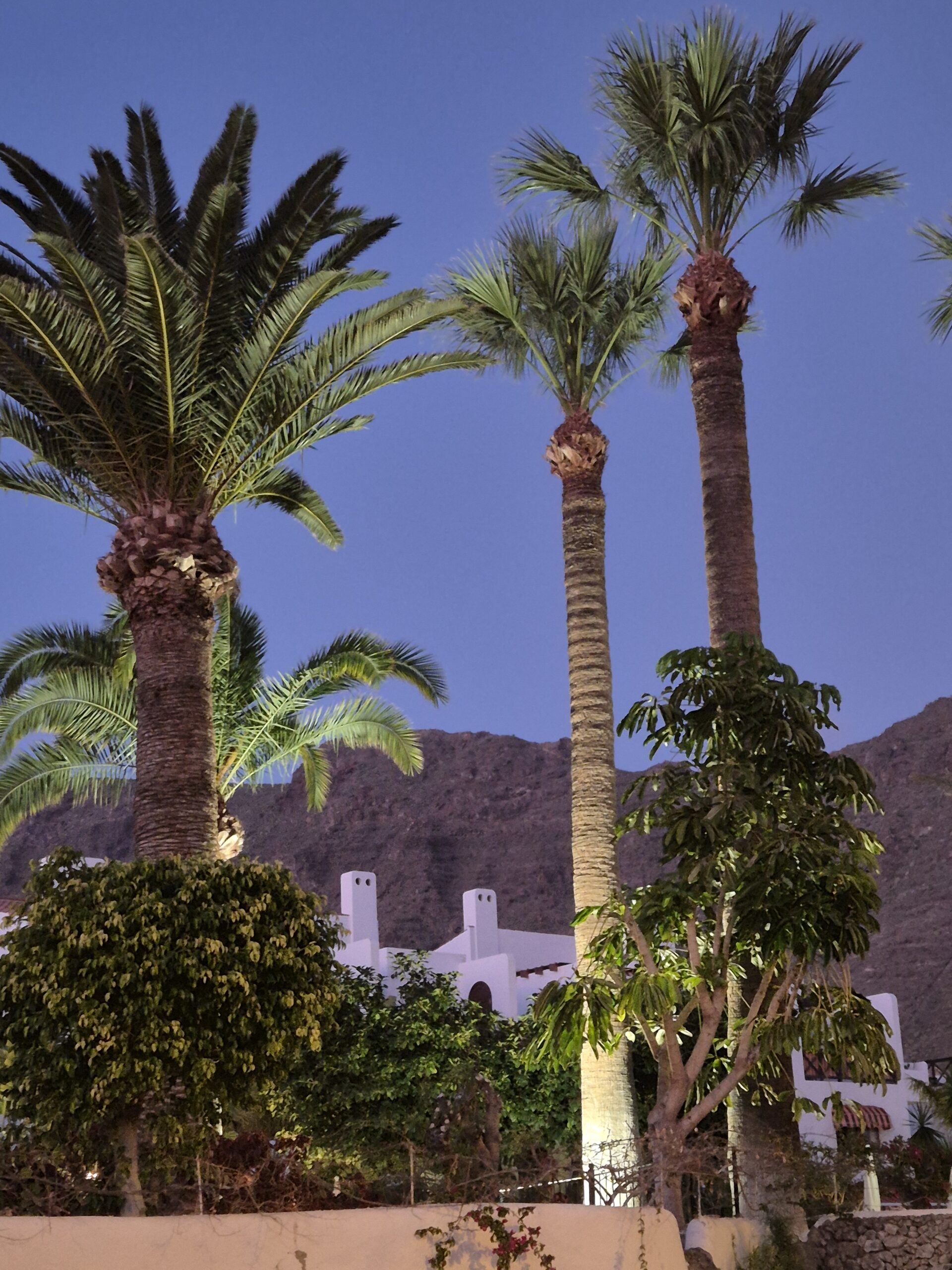
Palm trees were also explored. B presumed they all grew coconuts. By the end of the week she’d worked out most grew bananas, some grew dates and some papaya.
The boomerang tree
Palm trees, cacti and orange trees were all great but they paled in comparison to B’s standout favourite. She spotted it while we were driving along and shouted:
B: “Look! That tree grows boomerangs!”
On the third visit past we had to stop while she retrieved one.
It was a pod. About two foot long and brown. It was very hard and when you shook it, it rattled. It was very satisfying and became B’s best plaything for the week. Eventually she agreed that we could cut it open to see what was inside, which took a lot of destructive effort. We finally removed some small stripy seeds.


I’d decided it was a carob tree. B liked the idea it held something a bit like chocolate. However, when the seeds came out we decided it was actually a poinciana. They were everywhere once we started spotting them and the obsession was slowly spread round other families we met. Surely the best ‘fruit’ of all time for playing with.
Stargazing
We’re enthusiastic but amateur stargazers continually thwarted by circumstance. Every time we try at home it’s either too cold, too exposed, too lonely, too moonlit or too cloudy. Turns out it really helps if you can be somewhere hot where it gets dark fairly early.
Teide is a dark sky reserve with amazing views of the Milky Way. We never made it that far (the logistics of getting up a strange mountain in the dark defeated us). However it was possible to see the stars really well from the town we were based in. We took a walk by the sea and found a comfortable seat to look up on.


We’re good at Orion now and we had a good stab at spotting Sirius (the brightest) too. There was a quarter moon shining moonlight on the water. We failed to find the plough or the seven sisters but we still felt quite chuffed.
Teide, walking on lava and the north
Mount Teide, at 3,715m, is the stand out, obvious, natural attraction in Tenerife. There is a cable car that goes up it to the top and walks of varying difficulty at the bottom. The landscape changes from palm trees near the sea to tall forest trees halfway up and bare volcanic desert nearer the top.


We pretty much failed to get ourselves organised. The cable car, which B was desperate to go up in, needs to be pre-booked quite a long way in advance which we failed to realise. You also need to wear proper shoes (ie, not beach shoes or sandals) to be allowed in which we hadn’t got.
We decided against a tour and opted to drive ourselves which I think was a good move. Instead of being stuck on a coach for hours we found some amazing walks and panorama’s along the way. B LOVED ‘walking on lava’ and climbed through the rocky landscape like a monkey. She also collected bits of lava to take home to her friends. We all enjoyed seeing the landscape change as we got higher and higher. We got so distracted we ended up going no further and opted to drive back and head further north to see a different bit of the Island instead.
The north side is less tropical and more green and also more inhabited by residents as opposed to just tourist infrastructure. There we found the almond and orange trees and lovely walks through a more Mediterranean eco-system.
Playing on beaches and feeding fish


We stayed on the west side of the Island and the beaches there were great and covered in black volcanic sand (as opposed to the south beaches where white sand has been shipped in). B was fascinated and gathered some up to make a Tenerife beach scene with. Paddling led to feet covered in black sand. The sea was clear and was great to swim in and there was good signage as to where was safe and where was not. The surf was high in places but there were lifeguards on duty.
There were natural pools near us which were not considered safe but were still full of people and looked lovely. Closer inspection revealed them to be incredibly slippery.
Our local beach had large volcanic rocks on it as well as sand which made a challenging new kind of makka pakka tower. Getting it to balance was tricky and there was a lot of heavy lifting involved but we were satisfied with the result. Someone had made a beautifully artistic one on the beach which we copied shamelessly to the best of our ability.


The local marina at Los Gigantos had interesting boats (and shops and restaurants) and clear blue water in which lots of large fish were hopefully swimming. I suspect they are normally fed with whatever people have to hand. We did some research and revisited with a large pot of frozen peas and some bits of salad. They were very much appreciated.
Geckos, doves and other creatures
There was no shortage of land based wildlife. It took B three days to find a gecko but then she was obsessed. She never got one to go on her hand (though not for want of trying) but became expert at spotting them. She also spent a while trying to make friends with the local (and partly feral) cats.


It was the birds who gave us our best memories though. The air was filled with different calls from birds we hadn’t seen before. It took us ages to work out what the noisy one that sounded like a parrot looked like (surprisingly small, cream and black but very loud). There were also squawky black ones we hadn’t seen before and lots of sparrow type ones.
But the best was outside the door to our apartment where, at the top of a palm tree, two collared doves were busy making a nest. We see collared doves at home. These looked very happy in their tropical surroundings. They were very busy building and didn’t seem to mind being watched at all. Then, to our amazement, we walked out one morning to see a finished nest with one single, beautiful white egg in it. We wished we could stick around to see it hatch.


…and the things we paid to do…
Feeding the guinea pigs at the Monkey Park
We avoided the big zoos over worries about their animal welfare policies and went to Monkey Park instead. Here, ironically, the big attraction were the herds of guinea pigs roaming about asking for food. I’ve never seen guinea pigs in such numbers. They were very cute and looked like they were in their ideal environment.


We purchased two boxes of food (cut fruit and veg) at the entrance and B roamed about hand feeding any that asked her. There were lemurs, a tortoise and a squirrel monkey around too but they’d all been fed already and weren’t feeling sociable which we felt was fair enough. The rest of the park had an array of lots of different types of monkeys, tortoises, turtles, crocadiles, parrots and canaries.
Picking a pearl
We also did the expensive ‘picking a pearl‘ experience. You select a pearl (a bit like hooking a duck) by using a net to pick a mussel shell out of a prepared area. The staff then open the mussel to reveal your pearl and will then set it for you in a piece of jewellery.
I suspected this would cost more than the up front costs and I was right. They say it’s 15 euros to pick a freshwater pearl and 35 euros for a saltwater one (which is bigger and worth more). However, once you’ve picked it the jewellery settings and significantly more expensive. We ended up paying 50 euros for a simple bracelet setting. There didn’t seem to be an option where you just walked away with your pearl.


That said, I think it was worth it. B is getting into jewellery now and I think having something she’s ‘fished’ and seen being made has a value all it’s own. She was disappointed it was so easy to hook out the pearl but we’re going to be keeping an eye out for pearl mussels in the wild from now on.
Going whale and dolphin spotting
Working out the problem…
The big main ‘to do’ on our list when we arrived was to get out on and in the water and see what sea life we could. The waters round Tenerife are a whale heritage site and the southern beaches are residents to a turtle population. B has seen dolphins off the coast of West Wales but the possibility of seeing whales and turtles are making her hugely excited.
Working out how best to go about this turned into a week long exercise in damage limitations and reality clashing head on with unrealistic expectations. B is dreaming of swimming along and seeing a turtle (as per the wonderful photos online of snorkelers). She’s also thinking whales automatically mean blue whales. I rashly promise snorkelling and kayak trips and then realise these might be too extreme for a small ten year old. They talk of kayaking for 2-3 hours with snorkelling in the middle from the boat. Realistically I think she’ll struggle with this, particularly as it’s not that warm (about 22°C) but the sun is strong enough to burn our pale Welsh February skin to a crisp. I envisage her being trapped in a situation she can’t get out of.


We look at boat spotting trips instead and again I worry about sun exposure (some have no shade) and too long out at sea (2-4 hours). The good news is that there is no shortage of options including a pirate boat and several trips led by marine biologists. There’s also a submarine option which B loves the idea of but which sounds a bit claustrophobic.
…finding a solution…
In the end, after several days of agonising and expectation adjusting, we opt for the Royal Delfin boat. It’s a long trip at 4.5 hours (the 2 hour one is unavailable on the days we have), but the boat has shade, air conditioning and an underwater viewing chamber. It stops and anchors in the middle so you can swim off the back of the boat too.
…and learning lessons the hard way.
All the worries were well founded. It was flat as a pancake but, it turns out, B is not a good sailor, felt rotten throughout and was sick several times. The crew were totally amazing. She also had too much sun which didn’t help. She found the swimming off the back terrifying in practice. I think we were right to avoid the kayak and snorkelling options. But…


…she still says it was worth going because we were incredibly lucky with wildlife. The boat disturbed flying fish in the water who flew nimbly away in front of the boat. After lunch we sailed straight into a pod of bottlenose dolphins who loved the waves caused by the wake of the boat and jumped over them before swimming underneath and around us. Half an hour later we met a large pod of atlantic spotted dolphins, including several mothers and babies, who swam along with us for quite a way. Finally, almost back at the dock, we came across a small group of short finned pilot whales dozing in the sunshine who helpfully swam under the boat to pop out by a very poorly feeling B. This cheered her up considerably.
There were other children who were having a wonderful time and, as said, the crew were really amazing and very kind. I think, with hindsight, we’d still do it for the memories but definitely work out if any of you are likely to get sea sick before you start. We know now.
Conclusions
There are so many amazing things to do in Tenerife, most of which will be on your doorstep wherever you are. We had a brilliant time and B learnt a huge amount about different environments and ecologies without noticing she did. I suspect we’ll go back again and see what more can be discovered, maybe when she’s a bit older and ready for some serious snorkelling.


