
From being a complete novice a few years ago, we’re now, as a family, getting quite good at making fires. Here’s the instructions I wish I’d had when we started and some ideas of how to play with fire safely.
Location, location, location…
Finding the right place to have a fire is probably the most important bit (and the thing I’ve ignored most often at my peril). You need somewhere that is:
- Not too near a building
- Not underneath anything (ie, a tree)
- Sheltered from the wind
I know these are a bit contradictory! It’s when garden walls come into their own.
Also think about how you’re going to sit or stand round it and how easy it is to access. Our garden is not well suited at all as it’s all uneven ground and slippy bits as well as being small. We’ve got a corner, near the garage/shed, with walls on two sides where you can just about fit one in.
What will you have it in?
When you’re deciding how to have it, getting something designed to have fires in is a good idea. It will be much safer and it’s more likely to burn. We have an old chiminea which has been hanging round the garden for years and a, slightly newer, fire pit. They both work well. I prefer the fire pit as you can see the fire better and it’s easier to access but the chiminea is probably safer. You can also buy lots of different types of device from buckets to very posh fire table things.


If you’re planning to light one without a container for it think about how to keep it dry and safe. We made one on the beach last January and found stones were really helpful at providing a dry bottom, sides to keep it from the wind, and holes to let the air through. Sand works as a base too.
What do you make it from?
There’s so many answers to this. Here are three different options from easy to hard!
A fire log (The easiest option)
These are ridiculously simple. You can buy them at most supermarkets. All you do is place it in the fireplace and light the end with a match. It will then burn happily for a few hours.
They’re a great starting point and useful if you’re a bit nervous, short on time or limited on space.
Charcoal based (our favourite at the moment)
After some advice from a neighbour we currently use charcoal for our fires. There are some great companies out there making it in a traditional way and I think it’s one of the more environmentally friendly options.
You’ll need firelighters (we use the eco ones if we can find them), kindling and charcoal. I put the kindling in first with the firelighter in the middle so it’s touching as much as possible. Then pile charcoal a bit on top and round the edge (so it’s touching the kindling while leaving air for the fire).
You light the firelighter and the kindling should go up quite quickly. As it burns the charcoal will slowly catch too. The fire is ‘ready’ when the charcoal is burning properly. This can take a bit of time.
The ‘proper’ way (hard and dangerous)
One of our projects for the next year is going to be to try to make fires outside in natural spaces more with the resources we find there. I’m very aware that this can be very dangerous and needs a lot of care and attention. It’s definitely not something to do unless you’ve thought through the logistics very carefully. When fires go wrong it can be very scary, very quickly.
Before attempting it you need a place first off where NOTHING ELSE CAN CATCH FIRE! I would strongly recommend a beach or campsite and advise against doing anything in a wooded or grassy area without expert supervision.
That said, if you can find a safe way of doing it it’s a fantastic way to teach kids about fire. We’re planning to look for dry twigs, sticks and leaves and see if we can use them as firelighters and kindling. We’ll use stones to prepare an area and triple check it’s safe before we start.
I anticipate that we’ll struggle a lot to get it going and that, if we succeed, there will be a lot of smoke. I’ll report back when we get there!
Getting the kids involved
So how can the kids help? Actually they can do most of the above and it’s really good to get them doing the safety checks as well as the making bits. They need a lot of supervision of course but generally I think they also really enjoy it. Apart from the lighting (you’ll know when your kids old enough for that), they can do most of it very early.
Once the fire’s lit have a go at the following:
- Find stuff to burn! (B’s favourite is lavender and sage. Both smell as they burn). nb. this will cause the fire to smoke a lot!
- Look for fire spirits in the flames
- Talk about fire safety (which bits are hottest, etc)
- Blow on the charcoal to see it go red
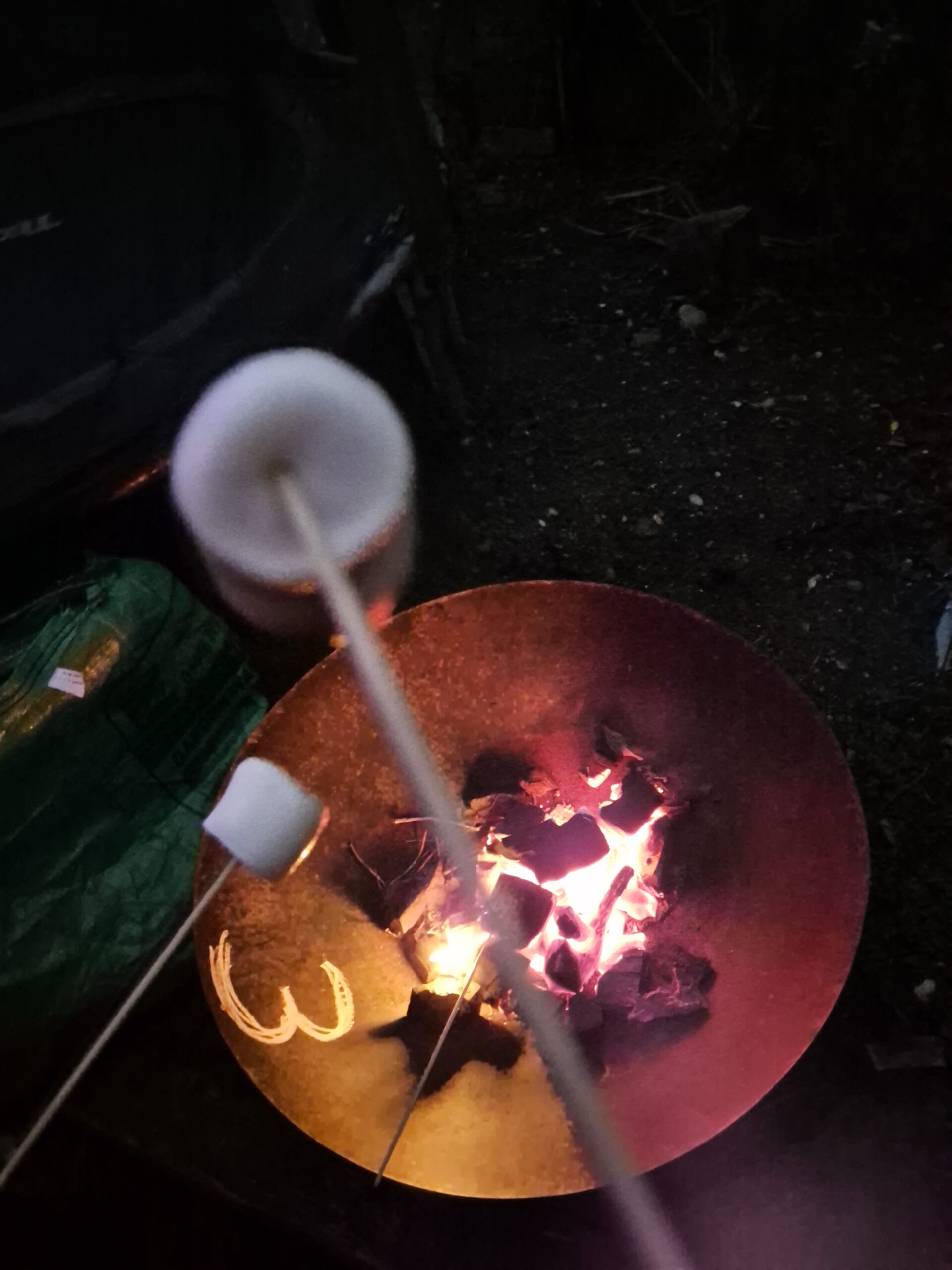
- Roast marshmallows
- Light sparklers
- Throw powder in to make the flames change colour


Some fire safety tips
Hopefully you’ll never be in a situation where a fire goes wrong but I worry about this sort of stuff a lot so this is my checklist to make sure I’m as safe as possible.
- Don’t put too much charcoal or fuel on
- NEVER USE FLAMMABLE LIQUID
- Have a source of water/bucket of sand nearby in case of emergency
- Double check the distance from occupied buildings
- Check there’s no gas, petrol or other very flammable substances in the area
- Make sure the area around it is clear and there’s no trip hazards
If you’ve followed all the advice above you should be ok. Remember that fire can only burn what you give it. So long as there’s not too much fuel it will burn out in the end so long as it’s contained in a suitable vessel.
If you’re going to burn leaves, flowers etc (which is very fun) remember it will smoke. If you are alarmed about the fire and put water on it be aware that it will be explosive. We had to do it once and the smoke and noise was really scary, though it did put it out.
For more information on using fires safely here are a couple of good links:
For US based readers Shamie Law have produced a great guide and say the following:
Teaching kids about fire safety is essential for keeping them protected at home and beyond. This guide offers simple, practical tips to help children understand fire risks, stay prepared, and know what to do in case of an emergency.
UK based readers may want to check out this great and very comprehensive post on campfires by UKSN.
Finally, remember your neighbours…
We have a small garden and near neighbours who are very tolerant but it can be antisocial having a fire. The smoke can drift a long way and it makes your clothes smell. Make sure neighbours don’t have washing out before you start. If you’re on a beach or outside make sure you’re away of those around you.
Good luck, have fun, stay safe and make some brilliant memories to look back on.


